
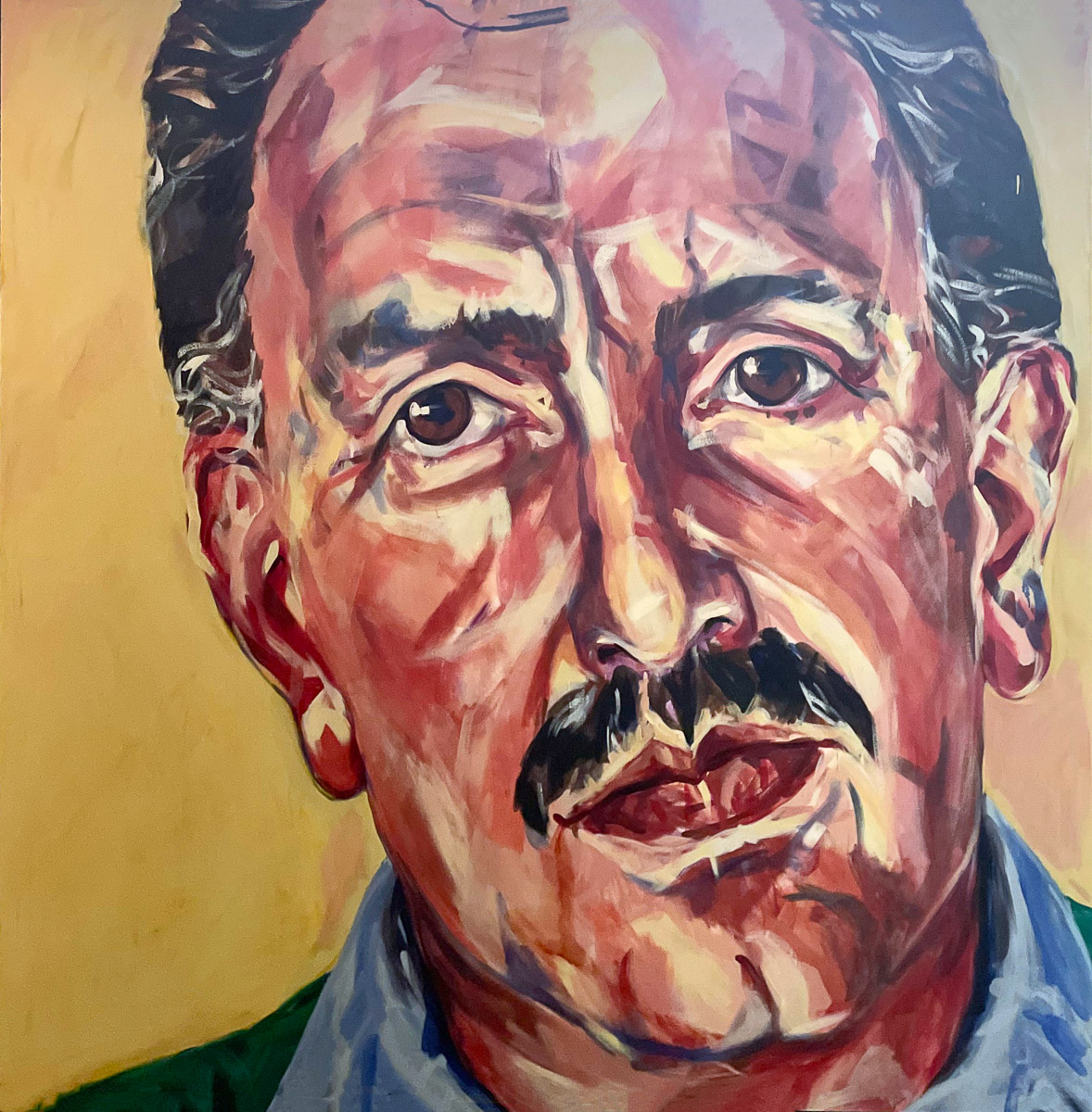
Lynn Donoghue
(1953–)
(–2003)
Lynn Donoghue (1953–2003) was born in the north-western Ontario community of Red Lake. In the early 1970s, she became well-known in Canada for her large-scale, colourful portraiture. She studied at H. B. Beal Secondary School in London, Ontario, where she trained under Paterson Ewen and Herb Ariss, completing a Special Art Diploma in 1972. Donoghue worked across Ontario as an arts educator and exhibited consistently in solo and group shows across Canada between 1973 and 1999, passing away in 2003 from complications relating to diabetes.
Lynn was noteworthy for her use of strong colours and her ability to represent subtle personality traits accurately in her portraits. The intense depth of colour was created through her use of thin layers of paint—sometimes up to 10 layers in one area—creating translucent washes of colour on the canvas and an eerie yet luminous air around the figure. She chose most of her paintings’ subjects herself, resulting in a body of work which showed specific snapshots of the cultural community in Toronto and Ontario more broadly from the 1970s through to the early 2000s.
Working as an arts educator from the 1970s to 1990s, Lynn worked across Ontario at the Haliburton School of Fine Arts at Sir Sandford Fleming College in Haliburton; the Ontario College of Art in Toronto; Sheridan College in Oakville; the University of Guelph; and York University in Toronto.
Her work currently sits in collections across Canada, including at Mount St. Vincent University Art Gallery in Halifax, Nova Scotia; Museum London and McIntosh Gallery in London, Ontario; the National Museum of Botswana in Gamborone, Botswana; the Ontario Legislature in Toronto, Ontario; the Robert McLaughlin Gallery in Oshawa, Ontario; and the Vancouver Art Gallery.
Lynn was elected an academician of the Royal Canadian Academy of Arts (RCA) in 1991 and was awarded the Queen’s Golden Jubilee Medal in 2002 for services rendered to her community through her art.